Dual Prototype Evolving for Test-Time Generalization of...
Test-time adaptation, which enables models to generalize to diverse data with unlabeled test samples, holds significant value in real-world scenarios. Recently, researchers have applied this...
openreview.net
1. 배경
1) Test-time prompt tuning 방식은 Text ecoder를 통과해서 Gradient 계산을 해야하기 때문에 계산비용, 메모리에서 손해
2) 기존 VLM adaptaion 방식의 한계
- 과거 sample에 대한 정보를 축적해 나가지 않음
- 이전 연구는 Text, Vision 중 하나의 modality 만 활용하여 adaptation을 진행함
2. 방법
(1) Prototype Evolving
* Text prototype Evolving
1) N개의 Class descriptions를 생성하고, Text Encoder에 입력, Text embedding을 평균내어 Prototype 생성
2) Prototype update usin cumulative average
- 과거 samples에 대한 정보를 계속해서 update 하기 위한 방법
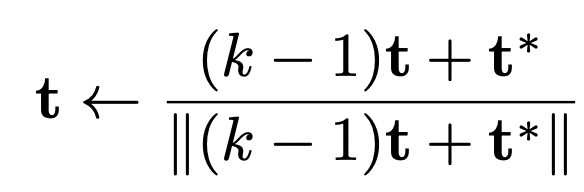
t : online updated prototype
t* : optimized textual prototypes
* Visual prototype Evolving
1) Cache를 생성하고 Class당 n 개씩 Image feature를 저장함
- 이때 GT를 활용할 수 없으므로 Image feature에 대한 예측값을 Pseudo label로 Image feature와 pair로 저장
2) 한 Class의 Cache가 꽉차 있다면 Entropy가 낮은 것은 입력, Entropy가 높은 것은 Cache에서 삭제함
- 과거 samples에 대한 정보를 계속해서 update 하기 위한 방법
3) Visual prototype은 Image feature의 평균임
(2) Prototype-Based Inference
- Text, Visual Prototype 각각에 대한 logit을 합하여 최종 Logit 출력
- Visual logit은 affinity function을 통과 시킨 후 더해줌

v : visual prototype
t : text prototype
(3) Prototype Residual Learning
1) Residual Parameter
- Prototype + Residual parameter 후 L2 Norm
- 이때 Residual parameter는 0으로 초기화 되어 있으며, 이른 통해 Prototype을 안정적으로 학습시킬 수 있음
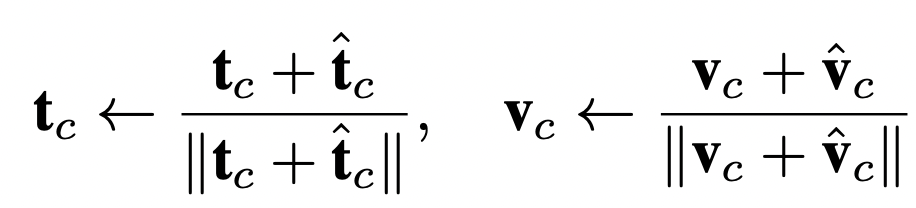
2) Entropy Minimization
- 최종 Logit에 대한 Entropy 최소화
3) InfoNCE loss
- Entropy loss만 사용한다면 모델은 overconfidence한 예측을 내도록 adaptation됨
3. 실험 결과
(1) 성능 비교

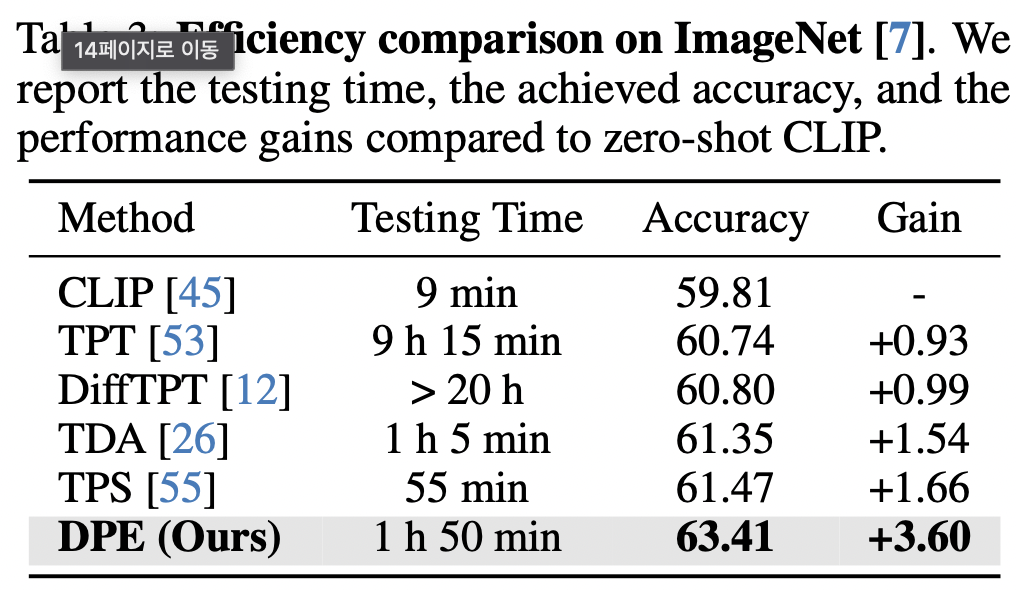
(2) 효율성 비교
4. 요약
- 기존 VLM adaptation 방식은 과거 sample에 대한 정보를 축적해 나가지 않으며 Text, Vision 중 하나의 modality 만 활용하여 adaptation을 진행.
- 이를 해결하기 위해 Text, Visual prototype을 동시 활용하며, Residual parameter와 결합하여 각 sample에 대한 Adaptation 진행
- Text prototype은 cumulative average, Visual Prototype은 cache의 image feature를 update 하며 과거 Sample에 대한 Adaptation 정보 누적


